

by Danny
We’ve been waiting for the sap to start running so we can continue to make maple syrup. And waiting. And waiting some more.
The ideal conditions for sap collection is above freezing temperatures during day, and below freezing at night. Unfortunately, it’s been consistently so dang cold that nothing has really happened. Then we had one glorious day with full buckets, and now it has been consistently above freezing – so no more sap. Sheesh.
Since we can’t elaborate further on our personal progress, I’ll share a few particulars I’ve recently gleaned about making maple syrup and then add in a killer recipe for your Easter brunch to boot. Ready?
1. In my last post, I mentioned that the tapping process introduces a small wound to the tree, which will eventually scar over – so you don’t want to tap your trees too early. To avoid the reduction in flow from the tree’s natural scarring process, some producers will “dope” their taps. Although this would be crazy diluted in the final product, it’s bad for the tree and no one wants to eat that dope anyways, and organic producers don’t do this.
2. Organic producers can’t tap a tree that is smaller than 9 inches in diameter. It’s bad for the tree to do so.
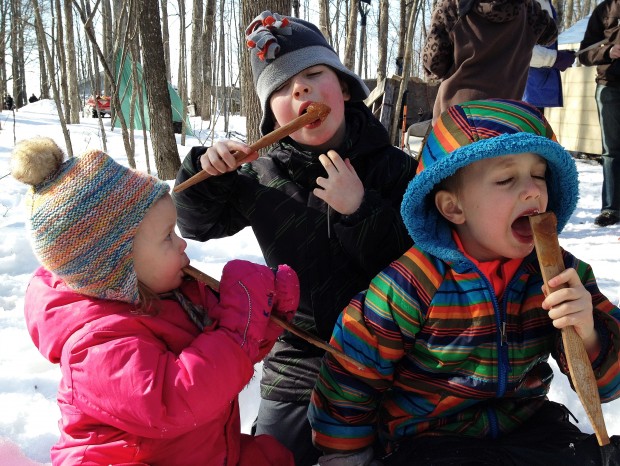
Our kids enjoying maple taffy.
3. Anyone who makes candies knows that when you boil sugar, you risk crystallizing your sugar. The same applies for sap, and eventually, the boiling pans get rock-hard maple crystals on them that need to be removed. Organic producers use Sodium Bicarbonate (old method) or very strong vinegar (newer method) with lots of rinsing to remove these rocks, which takes more time than other kinds of acids.
4. It takes a lot of energy to boil the sap, so maple producers can extract some of the water initially via reverse-osmosis to increase the sugar concentration. If your producer is organic, they can only increase the sugar concentration (brix) four-fold. At the beginning of the season, the brix of the sap is around 1, and at the end of the season, it is around 2.7. The final product, delicious maple syrup, has a brix level of between 66 and 67.
5. If you do too much reverse-osmosis, you will remove more of the maple properties and flavours.
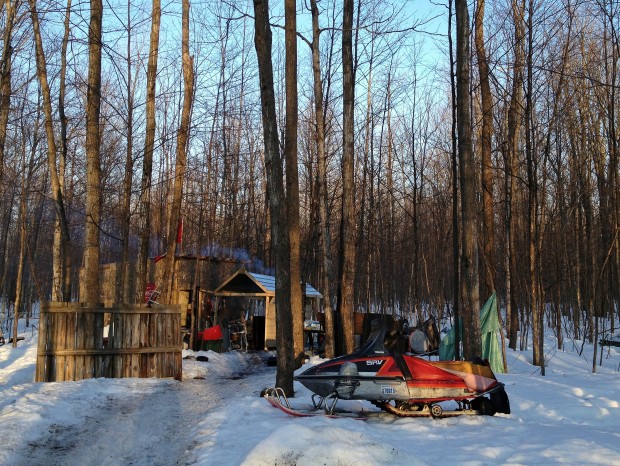
The sugar shack at dusk.
These facts are true of all maple syrup, whether organic or not.
6. Maple water from the trees at the beginning of the season has strong anti-oxidant properties, but later in the season, sap comes in to the mix, and these properties are diminished.
7. The faster you boil, the clearer your end product will be. The longer your maple water/sap is exposed to heat, the darker the end product will be. Ideally, you boil from near-frozen to syrup as quickly as you can.
8. If the syrup is canned at a too high or too low temperature, it will not “can” properly. Ideal is to have a vacuum in the can, so you should hear a sucking sound when piercing the can, similar to when you pry the lid off your homemade preserves in your Mason jars.
9. If the syrup is not properly filtered, it can develop “filaments”, which are simply a visual imperfection, but don’t affect taste. This will happen after about a year in the can.
10. Syrup in a can, if properly preserved, has a shelf life of about 4 years.
Maple Sausage Patties

| Maple Sausage Patties |
Print
|
- 2 pounds ground pork, (not lean, about 20% fat)
- 2 Tablespoons pure maple syrup
- 2 teaspoons salt
- 1 teaspoon freshly ground black pepper
- 2 teaspoons minced fresh sage
- 1 teaspoon minced fresh thyme leaves
- 1/2 teaspoon minced fresh rosemary
- 2 Tablespoons bacon grease, ghee, or fat of choice
- Place the pork in a large bowl and pour the maple syrup on top. Sprinkle the the remaining ingredients on top, except the fat.
- Use your hands to gently mix everything together; be careful not to overwork the meat or it will be tough.
- For the pork into sixteen 2-inch patties, about 3/4-inch thick.
- Melt a tablespoon of the fat in a large cast iron skillet over medium-high heat. In two batches, cook the sausage patties for about 4 minutes on each side. They will get dark brown and feel firm when cooked through. Serve hot with additional maple syrup.
How do you like to cook with maple syrup?
10 things you probably didn’t know about making maple syrup (Recipe: Maple Sausage Patties) is a post from Simple Bites
© 2010-2014 Simple Living Media, LLC | All rights reserved - This feed is provided for the convenience of Simple Bites subscribers. Any reproduction of the content within this feed is strictly prohibited. If you are reading this content elsewhere, please contact hello@simplelivingmedia.com to let us know. Thanks.


